


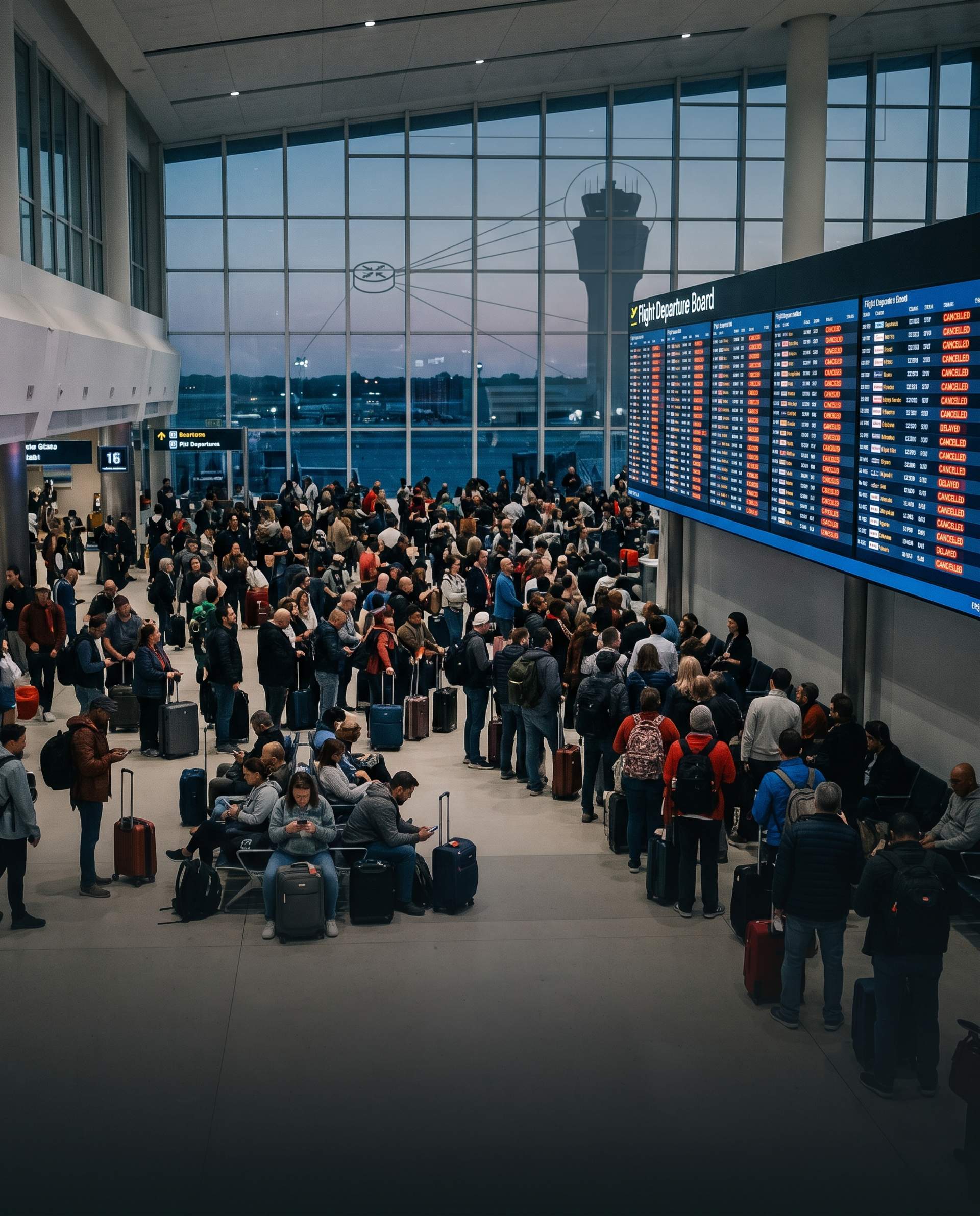
A telecommunications upgrade intended to modernise America's ageing air traffic control network has been linked to a nationwide flight shutdown that disrupted thousands of journeys, raising fresh questions about the reliability of critical aviation infrastructure.
The Federal Aviation Administration (FAA) ordered a nationwide ground stop on Friday, November 13, after communications problems affected air traffic control operations. The restriction lasted nearly five hours before flights were gradually allowed to resume.
The disruption continued into the weekend as airlines struggled to reposition aircraft and crews. Reuters reported that more than 20,000 flights had been disrupted by Saturday, including cancellations and delays. The FAA said the air traffic control system had stabilised, but warned that passengers could continue experiencing disruption while normal schedules were restored.
How a routine upgrade became a national problem
US Transportation Secretary Sean Duffy said the incident began during maintenance work at a remote FAA location, where contractor L3Harris was replacing ageing copper telecommunications lines with fibre-optic connections.
According to the administration's account, a router involved in the work began sending more than 1,000 connection attempts to other routers every four to five seconds. The resulting traffic disrupted communications with aircraft and affected some radar feeds.
Officials said the FAA could not quickly isolate the problem and ordered the ground stop as a precaution to protect aviation safety.
The precise technical fault remains under investigation. Authorities have not established whether the problem involved an installation error, incorrect configuration or defective equipment. L3Harris has said it is supporting the investigation.
The US government has also said there was no evidence that a cyberattack caused the outage.
A warning about infrastructure modernisation
The incident has highlighted a difficult problem facing large public infrastructure systems: replacing old technology without interrupting the services that depend on it.
Air traffic control relies on continuous communication between controllers, aircraft and surveillance systems. Even a temporary loss of reliable information can force authorities to restrict operations while they establish that flights can continue safely.
The FAA's network has been undergoing a wider modernisation programme, but the latest disruption has exposed the risks of maintaining legacy equipment while introducing newer technology.
The Department of Transportation said more than 3,500 flights were grounded during the initial response. Reuters reported that the wider disruption affected more than 20,000 flights through cancellations and delays.
What happens next?
The FAA and L3Harris are investigating the equipment and maintenance work involved. Officials have also discussed additional safeguards and the need to accelerate the replacement of ageing communications infrastructure.
For passengers, the immediate priority is the restoration of normal airline schedules. For regulators and lawmakers, the incident raises a larger question: how can a system responsible for managing one of the world's busiest airspaces be modernised without creating new vulnerabilities during the transition?
The shutdown did not establish that fibre-optic technology itself is unsafe. Rather, it demonstrated how a failure at one point in a connected network can have consequences far beyond the location where maintenance is being carried out.




Comments
0