


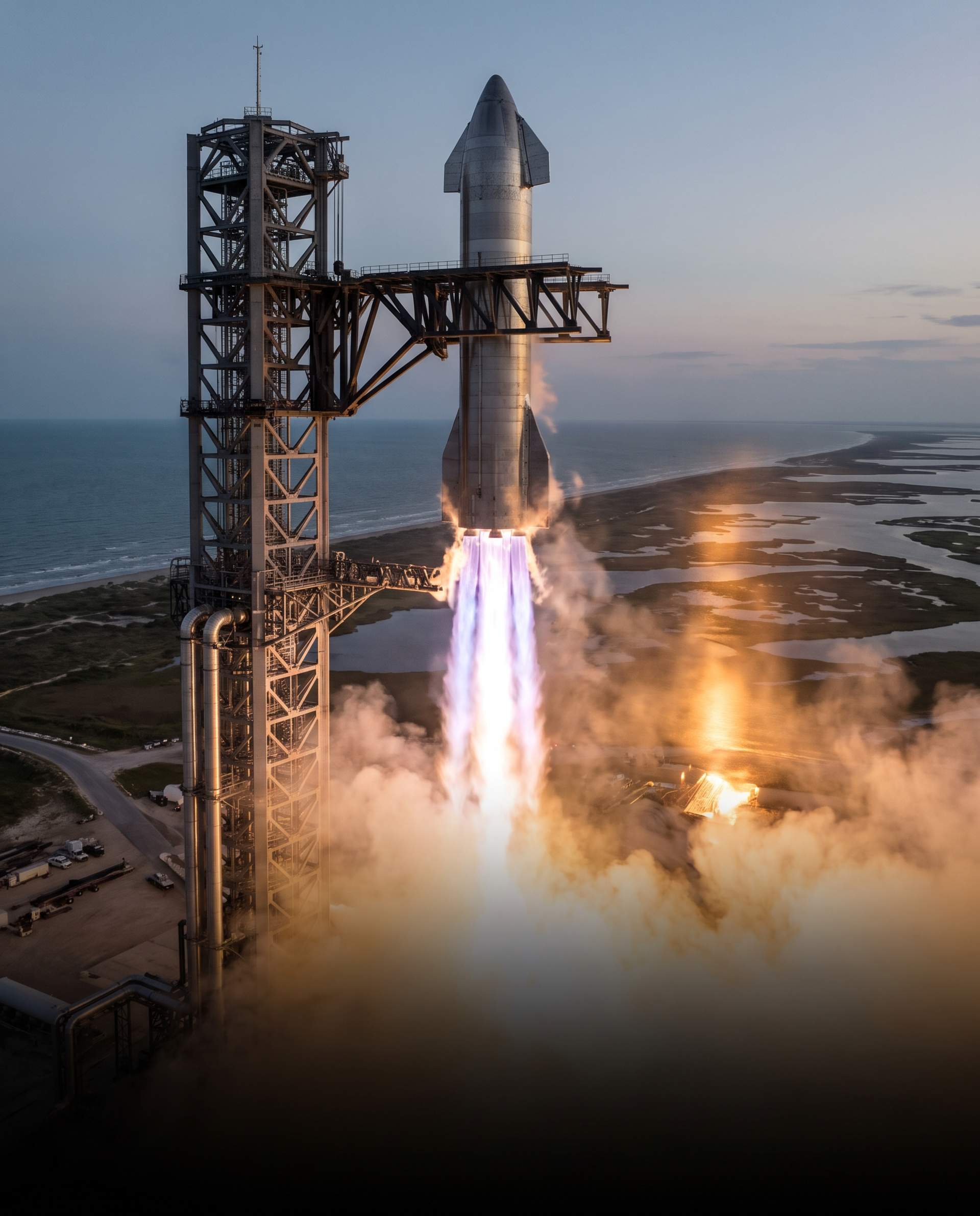
SpaceX has achieved a watershed victory in modern aerospace engineering, executing an almost flawless full-duration orbital test flight of its mammoth Starship launch system that saw the upper stage survive extreme atmospheric reentry before touching down with pinpoint accuracy.
The successful mission, launched from the company's Starbase facility at Boca Chica, Texas, validated core engineering technologies essential for deep-space travel. Powered by thirty-three methane-fueled Raptor engines generating over sixteen million pounds of thrust, the Super Heavy booster propelled the stainless-steel spacecraft into an orbital trajectory before separating and returning to the launch pad, where it was smoothly captured mid-air by the mechanical arms of the launch tower.
Conquering the Perils of Atmospheric Reentry
While booster recovery had been demonstrated in previous test flights, the primary technical objective of Friday's mission centered on the upper Starship vehicle's thermal protection system.
During orbital reentry, spacecraft plunge into Earth's upper atmosphere at velocities exceeding twenty-seven thousand kilometers per hour, generating intense frictional plasma envelopes reaching temperatures above 1,400 degrees Celsius. In earlier test campaigns, extreme heat burned through flap joints and melted exposed aerodynamic control surfaces.
For this flight, SpaceX engineers redesigned the heat shield, installing over eighteen thousand hexagonal ceramic tiles backed by secondary insulating blankets and reinforced metallic seal joints around movable forward and aft steering flaps. Live onboard cameras beamed back dramatic video showing glowing purple plasma wrapping around the spacecraft as it executed hypersonic maneuvers across the Indian Ocean, maintaining structural integrity and telemetry links throughout the descent.
In-Space Engine Relight and Propellant Management
Another major technical breakthrough accomplished during the flight was the successful in-space relight of a Raptor vacuum engine while coasting through the vacuum of low Earth orbit. Reigniting cryogenic rocket engines in microgravity presents severe fluid-dynamic challenges, as liquid methane and oxygen tend to slosh and float away from fuel intake pumps.
To overcome this, engineers used internal cold-gas thrusters to settle the propellants at the bottom of the tanks before initiating the ignition sequence. Proving reliable in-space engine restarts is an essential prerequisite for future orbital deorbit burns and interplanetary journeys toward the Moon and Mars.
Accelerating NASA's Artemis Lunar Timeline
The successful test carries immense significance for NASA's Artemis program, which relies on a specialized variant of Starship to serve as the Human Landing System for returning American astronauts to the lunar surface.
NASA officials had expressed growing concern over development delays, pointing out that lunar landing missions require multiple uncrewed refueling flights in low Earth orbit before a crewed Starship can journey to the moon. By proving that the spacecraft can reenter, decelerate, reignite its Raptor engines in flight, and touch down safely, SpaceX demonstrated that the fundamental flight physics of the vehicle are mature.
Senior NASA administrators congratulated the SpaceX engineering team, confirming that the milestone keeps human lunar landing schedules on track for the late 2020s while paving the way for orbital propellant transfer demonstrations scheduled for next year.
Transforming the Economics of Spaceflight
Beyond government exploration contracts, the commercial implications of a fully reusable super-heavy launch vehicle are staggering. Traditional expendable rockets cost hundreds of millions of dollars per launch, discarding expensive engines and fuel tanks into the ocean after a single mission.
The Federal Aviation Administration has also signaled progress toward expanding SpaceX's annual launch license at Starbase, reviewing environmental impact assessments to permit up to twenty-five orbital launches per calendar year. Increased launch cadences will allow engineering teams to iterate rapidly, testing in-flight propellant transfers and long-duration life-support modules ahead of uncrewed lunar demonstration landings.
Starship is designed for rapid turnaround, with both booster and ship intended to fly multiple times per week. This full reusability is expected to reduce the cost of delivering cargo to low Earth orbit from thousands of dollars per kilogram down to less than one hundred dollars, unlocking massive expansion for global satellite constellations, space-based manufacturing, and interplanetary logistics.




Comments
0