


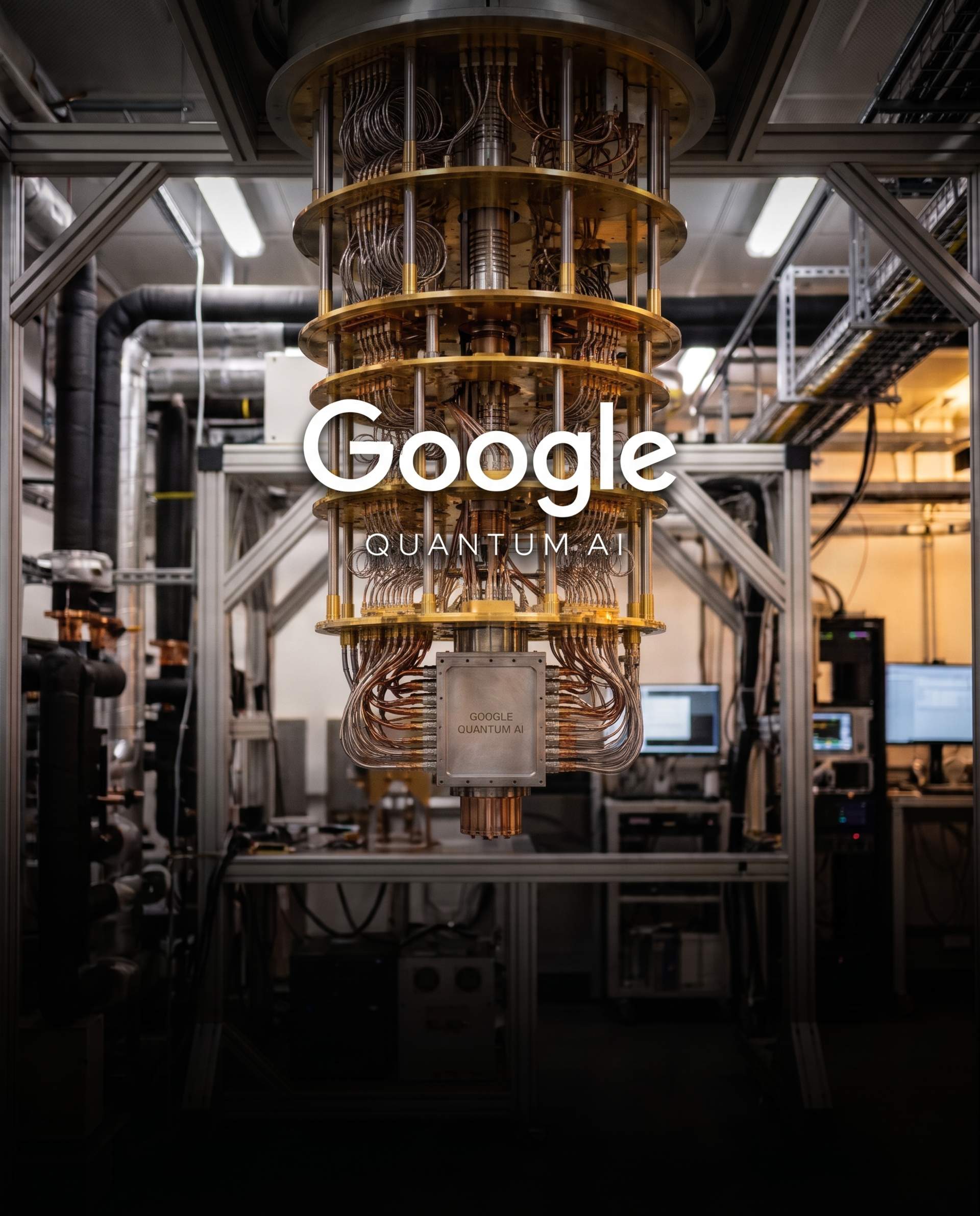
In a milestone that physicists are characterizing as a decisive turning point for modern computing, researchers at Google Quantum AI have achieved experimental validation of fault-tolerant quantum error correction, demonstrating for the first time that expanding the scale of a quantum processor systematically suppresses operational calculation errors below the critical physical threshold.
The landmark scientific demonstration, published in Nature, was conducted on Google's newly unveiled Willow quantum computing platform at its Santa Barbara research facilities. For more than three decades since the mathematical foundations of quantum computing were first laid, the field has been constrained by the fragility of physical qubits. Environmental thermal noise, stray electromagnetic radiation, and microscopic material defects inevitably cause individual quantum states to decohere, corrupting complex computational trajectories within fractions of a millisecond.
Surpassing the Holy Grail of Quantum Error Correction
The Willow processor overcomes this physical barrier through the implementation of two-dimensional surface codes. Under this scheme, information is not stored in a single physical qubit. Instead, quantum information is encoded collectively across an entangled array of dozens of physical qubits that together form a single, highly stable logical qubit.
The core theoretical requirement for useful quantum computing has always been that increasing the number of physical qubits per logical qubit must reduce the net logical error rate exponentially. Until now, every attempt to scale surface code arrays resulted in more noise, because the added physical components introduced more errors than the error correction circuits could remove.
On the Willow platform, Google's team proved that an expanded distance-seven surface code logical qubit exhibited an error rate significantly lower than that of a smaller distance-five or distance-three logical qubit. By crossing this long-sought breakeven threshold, the researchers proved that physical errors can be reliably suppressed through engineering scale rather than waiting for fundamentally noise-free quantum materials.
Precision Engineering on the Willow Architecture
Achieving this historic performance required radical architectural improvements across the entire cryogenic and semiconductor stack. The Willow chip incorporates one hundred five superconducting transmon qubits fabricated on ultra-pure silicon substrates with novel aluminum-based Josephson junctions that cut microwave dielectric loss in half.
Each qubit operates inside a multi-stage dilution refrigerator chilled to within fifteen millikelvins of absolute zero, colder than deep interstellar space. The quantum engineering team developed custom cryogenic control cabling and high-density room-temperature digital control electronics capable of executing simultaneous two-qubit entangling gates with an astounding 99.9 percent gate fidelity across the entire grid.
To detect and fix errors in real time without collapsing delicate superposition states, the system performs continuous syndrome extraction cycles in under two hundred nanoseconds. Ultra-fast field-programmable gate arrays decode error syndromes on the fly, applying mathematical corrections to the logical quantum register before runaway errors can propagate.
From Scientific Novelty to Real-World Computational Impact
The successful demonstration shifts the quantum computing race from theoretical physics exploratory experiments into systematic systems engineering. Industry analysts emphasize that building computers capable of running millions of consecutive quantum gate operations is essential to cracking problems that remain unsolvable for even the most powerful classical supercomputers.
Fault-tolerant logical qubits will enable computational chemists to simulate complex enzyme mechanisms, such as biological nitrogen fixation, paving the way for revolutionary low-energy fertilizers. In material science, stable quantum algorithms can model room-temperature superconductors and next-generation solid-state battery electrolytes with atomic fidelity.
The Roadmap to Commercial Superconducting Supercomputers
While the milestone is celebrated as a triumph, Google's leadership acknowledges that significant engineering hurdles remain before large-scale commercial quantum computers become an everyday reality. Transitioning from a single protected logical qubit to thousands of interconnected logical qubits will require scaling cryostats, managing thermal dissipation, and expanding automated control software.
Nevertheless, by mathematically and experimentally proving that quantum error correction works as theory predicted, Google Quantum AI has demolished the primary scientific uncertainty hovering over the discipline, charting an unmistakable flight path toward the era of practical, transformative quantum computational advantage.




Comments
0