


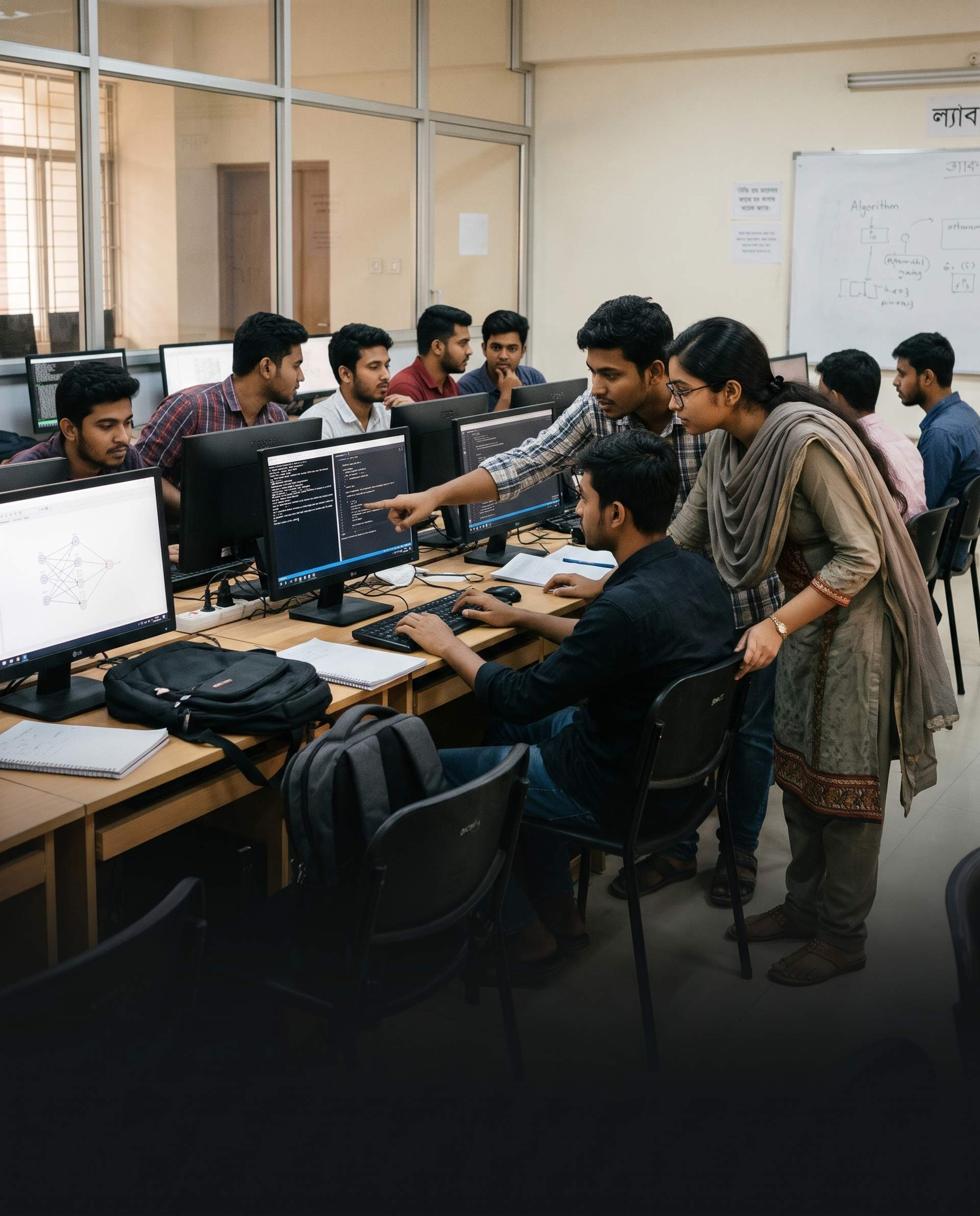
In a bold structural modernization designed to align Bangladesh's higher education system with the demands of the global fourth industrial revolution, the University Grants Commission has formally launched a unified national Artificial Intelligence curriculum accompanied by subsidized high-performance cloud computing sandboxes across thirty-five public universities.
The landmark educational initiative, developed in close collaboration with leading computer science faculty from Bangladesh University of Engineering and Technology, Dhaka University, and international academic partners, will immediately impact more than fifty thousand undergraduate students enrolled in engineering, computer science, and data sciences faculties nationwide. The strategic objective is to equip homegrown graduates with cutting-edge theoretical foundations and practical engineering skills, eliminating the chronic mismatch between university syllabuses and the fast-evolving requirements of the international software engineering marketplace.
Standardized Framework for Applied Machine Learning
For years, computing curricula across public universities suffered from fragmented syllabus designs, outdated textbook material, and inconsistent pedagogical standards between established metropolitan institutions and newer regional universities. Students outside major urban centers frequently lacked access to rigorous foundational coursework covering modern deep learning, neural networks, computer vision, and natural language processing.
The newly mandated UGC curriculum establishes a standardized, credit-bearing four-tier learning pathway. Beginning in the sophomore year, students will master mathematical prerequisites in multivariate calculus, linear algebra, and Bayesian statistics before progressing to hands-on coursework in transformer architectures, reinforcement learning, and ethical AI deployment.
The syllabus emphasizes practical, project-based capstone requirements where student teams must build functional applications addressing pressing national development challenges, including agricultural crop pest diagnostics, riverbank erosion modeling, and localized Bengali natural language processing tools.
Eliminating Hardware Barriers with Cloud GPU Sandboxes
Perhaps the most transformative aspect of the UGC program is the establishment of the National Academic Cloud Computing Consortium. Historically, the single largest barrier preventing Bangladeshi students from conducting competitive machine learning research was the severe shortage of specialized hardware. High-end graphic processing units capable of training multi-layer neural networks remain prohibitively expensive for university laboratory budgets and individual student households.
To permanently bridge this digital divide, the UGC has partnered with sovereign datacenter infrastructure and international hyperscale cloud providers to distribute pooled cloud GPU compute credits to every enrolled student and faculty mentor. Through a browser-based, secure terminal sandbox, students at regional universities in Sylhet, Rajshahi, Rangpur, and Patuakhali can write Python code, load large datasets, and train complex models on enterprise-grade hardware clusters without requiring expensive personal workstations.
Faculty members noted that this level playing field has already democratized student participation in competitive international academic hackathons and open-source software contributions.
Intensive Faculty Training and International Mentorship
Recognizing that curriculum success depends fundamentally on teaching excellence, the UGC has initiated a rolling series of intensive master-trainer workshops for over four hundred university lecturers and assistant professors. Leading Bangladeshi machine learning researchers and software engineers working in Silicon Valley, Singapore, and Europe are delivering advanced pedagogical modules on generative modeling, agentic workflows, and automated evaluation metrics.
Trained faculty will return to their regional departments equipped with standardized lecture slides, auto-graded laboratory assignments, and shared digital repository materials, ensuring consistent instructional quality across every participating campus.
Fostering Innovation and High-Value Export Growth
Industry leaders across the Bangladesh Association of Software and Information Services have enthusiastically welcomed the initiative, noting that a steady influx of industry-ready AI talent is vital to elevating the country's software export sector from basic IT support into high-margin algorithm design and bespoke enterprise software development.
By investing decisively in its young mathematical minds and providing them with the computational tools to innovate locally, Bangladesh is positioning its higher education system as an engine of sustainable economic transformation, ensuring that its youth lead the regional technological renaissance for decades to come.




Comments
0