


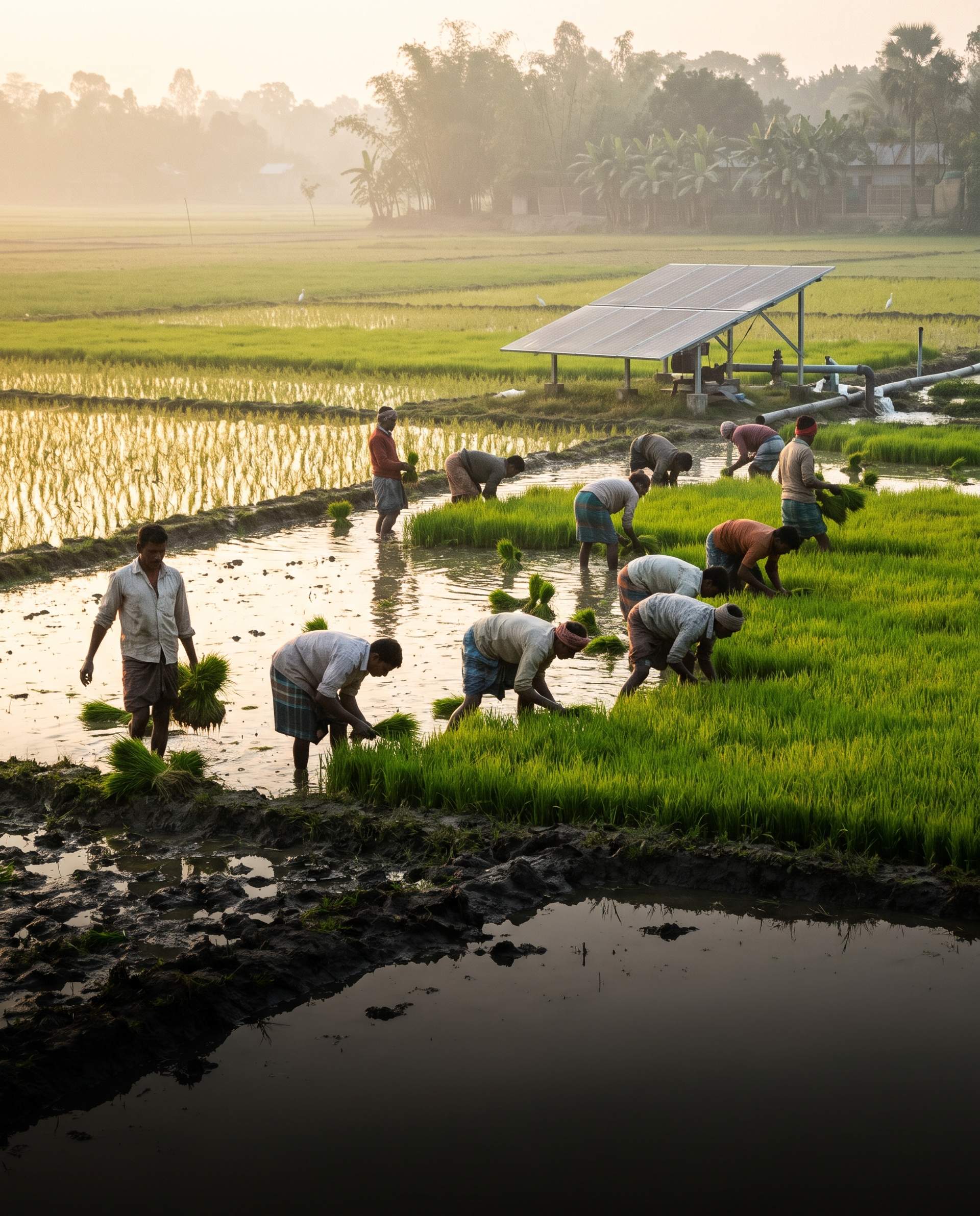
Agricultural extension officials and farming communities across northern Bangladesh began preparing extensive nursery seedbeds this weekend, formally inaugurating the winter Boro rice cultivation cycle with a record distribution of government subsidies on high-yielding hybrid seeds, balanced fertilizer vouchers, and solar-powered irrigation pumps.
The Boro season represents the undisputed foundation of Bangladesh's national food security. While monsoon Aman rice contributes significantly to household grain reserves, irrigated winter Boro accounts for more than fifty-three percent of the country's total annual rice output. With global grain markets experiencing volatility and domestic food inflation remaining an urgent concern for working families, the Ministry of Agriculture has set an ambitious production target exceeding 22.5 million metric tons for the upcoming harvest cycle.
Targeted Incentives to Lower Farm Production Costs
A primary hurdle facing grassroots paddy growers over recent cultivation cycles has been the rising cost of essential farming inputs. High retail prices for diesel fuel, commercial chemical fertilizers, and proprietary hybrid seed packets have squeezed farmer profit margins, discouraging smallholders from cultivating marginal cropland.
To directly alleviate this financial burden, agricultural field offices across Dinajpur, Bogura, Rangpur, and Naogaon have begun distributing direct input incentive packages to over two million small and marginal farmers. Under the state program, eligible growers receive five kilograms of stress-tolerant, high-yielding hybrid seeds free of cost, alongside subsidized vouchers providing ten kilograms of diammonium phosphate and ten kilograms of muriate of potash.
Agricultural extension officers noted that encouraging high-yielding varieties developed by the Bangladesh Rice Research Institute, such as BRRI Dhan 89 and BRRI Dhan 92, allows farmers to achieve yields of up to eight metric tons per hectare while shortening the field maturity window by roughly ten days.
Expanding Solar-Powered Deep Tubewell Networks
Perhaps the most significant structural transition this season is the aggressive rollout of solar-powered irrigation networks across the Barind tract and northern river basins. Traditional winter irrigation relies heavily on shallow diesel-powered engine pumps that consume millions of liters of imported fuel and contribute heavy carbon emissions.
Working alongside the Rural Electrification Board and rural development cooperatives, the government has connected hundreds of community solar irrigation installations. These solar arrays power high-efficiency submersible water pumps that draw groundwater during daytime sunlight hours and channel it through buried plastic distribution pipes directly into farmer plots without water evaporation losses.
Farming cooperatives in Rajshahi reported that switching from diesel engines to cooperative solar pumps has cut seasonal watering expenses by nearly forty percent, providing predictable, low-cost irrigation during critical seedling transplantation weeks in December and January.
Water-Saving Techniques and Sustainable Farming
To preserve underground aquifers, agricultural specialists are actively training growers in Alternate Wetting and Drying water management techniques. Instead of keeping paddy fields continuously flooded with water, farmers use simple perforated plastic monitoring pipes placed in the soil to observe water levels, irrigating only when water drops a few inches below the ground surface.
Field trials show that this technique cuts irrigation water consumption by up to thirty percent and significantly reduces methane emissions without harming final grain yields, helping farmers lower pumping costs while preserving vital groundwater tables for future generations.
Climate Adaptation and Cold-Snap Protection
Field scientists from the Department of Agricultural Extension have also launched educational awareness workshops to help growers shield tender young seedlings from severe winter fog and cold snaps.
When nighttime temperatures drop below ten degrees Celsius, young paddy sprouts can suffer from cold injury, turning yellow and rotting in standing water. Extension officers are instructing farmers on protective techniques, including covering seedbeds with clear polythene sheets during nighttime hours and maintaining shallow warm water layers in nursery beds to insulate root systems against morning frost.
Securing National Self-Sufficiency
Senior agriculture ministry officials confirmed that district fertilizer monitoring committees have verified robust buffer stocks of urea, phosphate, and potash in regional government warehouses, ensuring that local dealers do not create artificial shortages or inflate retail prices during peak transplantation weeks.
As green nursery seedlings take root across thousands of hectares in the northern grain belts, the dedication of local farming communities paired with timely state support offers strong reassurance that Bangladesh will maintain its hard-won self-sufficiency in staple food grains throughout the year ahead.




Comments
0