


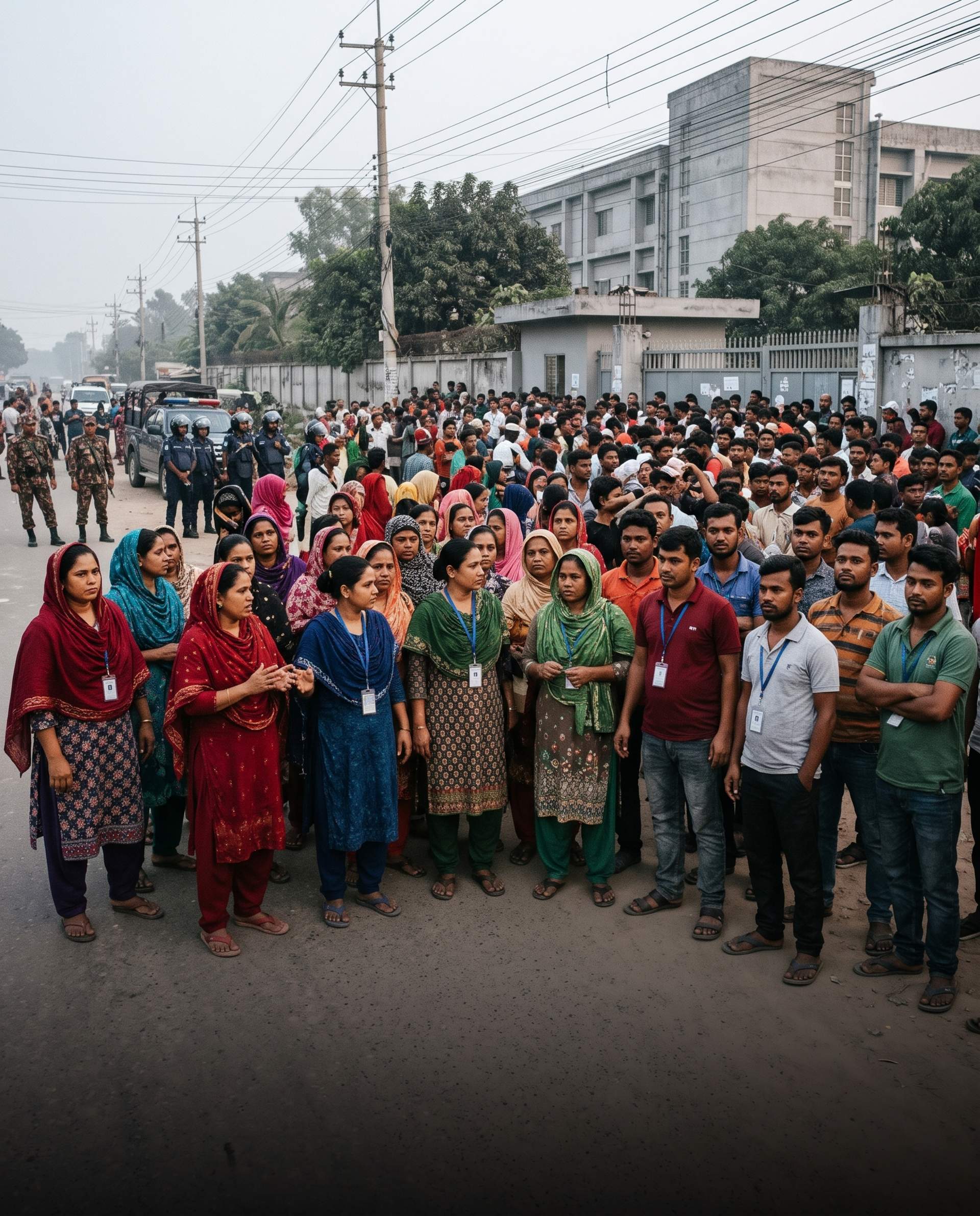
Bangladesh's garment industry is facing renewed labour unrest as workers demand higher minimum wages, factory closures spread across industrial areas and police use tear gas to disperse demonstrations in Gazipur.
Workers from two garment factories in Konabari blocked a road on November 16 after demanding a minimum monthly wage of Tk30,000. Police and Border Guard Bangladesh personnel responded to the demonstration, eventually firing tear gas shells and sound grenades to disperse the protesters.
The incident is part of a wider dispute over wages and working conditions that has disrupted production in Bangladesh's major apparel manufacturing centres. The outcome could have implications for millions of workers, factory owners and the country's export-dependent economy.
What happened in Gazipur?
According to The Business Standard, workers from ABM Fashion and Jamuna factories began protesting at approximately 8am on Monday without joining their shifts.
The demonstration moved to the Konabari-Kashimpur road, where workers blocked traffic. Police and BGB personnel arrived and asked the protesters to leave the road.
Tensions subsequently escalated, prompting law-enforcement agencies to fire tear gas shells and sound grenades. Workers dispersed, and traffic resumed.
Additional security personnel remained deployed along the Dhaka-Tangail highway and surrounding industrial areas. The report said 13 BGB platoons and 25 executive magistrates were on duty alongside police.
Dhaka Tribune separately reported the same demonstration and confirmed the police action. It also reported that at least 13 garment factories had been declared closed indefinitely since Sunday amid labour unrest and security concerns.
The immediate protest was therefore only one part of a much larger industrial dispute.
Why are workers demanding Tk30,000?
The central issue is the gap between workers' wage demands and the amount employers are prepared to offer.
Workers have demanded a minimum monthly wage of Tk30,000, while the workers' representative on the wage board has proposed Tk32,000, according to reporting by The Daily Star.
The current minimum wage structure was fixed at Tk12,500 in 2023. The dispute has intensified as workers seek an increase that better reflects their living expenses.
Reuters reported on November 11 that garment workers were struggling to cover basic household costs, with some families reducing spending on food, healthcare and education.
One worker featured in the Reuters investigation earned Tk13,500 monthly, rising to around Tk16,000 with overtime. She described difficulties paying for rent and food and said she had not visited a doctor in three years.
Another worker described how financial pressures affected her children's diets and education.
These accounts illustrate why the wage dispute is not simply about negotiating a higher figure. For many workers, the issue concerns whether their income can cover basic necessities.
Factory closures increase pressure
The dispute is also creating difficulties for factory operations.
The Financial Express reported on November 16 that 121 garment factories remained shut amid continuing labour unrest, based on information from the Bangladesh Garment Manufacturers and Exporters Association.
The report said 65 factories had been closed indefinitely under Section 13(1) of the Bangladesh Labour Act, while other factories had declared general holidays.
Under the provision, employers can apply a no-work, no-pay approach when workers cannot be provided with work because of a strike or other disruption covered by the law.
The Daily Star separately reported that nine additional factories had closed, bringing the reported total under the shutdown policy to 64 at the time of its report. Differences in reporting time and factory classifications mean these figures should not be treated as identical snapshots.
The closures have created uncertainty for workers who arrive at factories only to find that operations have been suspended.
Labour representatives have warned that withholding wages could deepen frustration rather than resolve the underlying dispute.
Employers and workers face difficult negotiations
Factory owners are also concerned about the financial implications of a substantial wage increase.
According to The Financial Express, employers' representatives were expected to submit a minimum-wage proposal to the Wage Board on November 16. Industry sources cited by the newspaper indicated that the proposed entry-level monthly wage could fall between Tk14,500 and Tk15,500.
That range remains a reported expectation, not an approved wage decision.
The workers' representative has proposed Tk32,000. The difference between the positions shows how difficult negotiations could become.
Employers argue that factories differ in their financial capacity, particularly smaller and medium-sized businesses.
Workers, meanwhile, face rising living costs and want a wage structure that reflects their basic needs.
Reuters reported that inflation in Bangladesh had averaged around 9% since 2022, adding to pressure on household budgets.
The government-appointed wage board will have to consider these competing concerns while determining a new structure.
Why the dispute matters beyond factories
Bangladesh's garment industry is central to the national economy. Reuters reported that the sector employs more than four million people and generates over 80% of the country's export earnings.
A prolonged shutdown could therefore affect more than individual factories.
Disruptions can delay production schedules, affect delivery commitments and create uncertainty for international buyers. They can also reduce workers' earnings, especially when factory closures continue for extended periods.
The industry must balance competitiveness in international markets with the need to provide workers with a sustainable standard of living.
The wage negotiations are particularly important because the new wage structure is expected to take effect from December 1, 2026, with enhanced payments beginning in January 2027, according to The Financial Express.
That schedule makes the coming negotiations important for both workers and manufacturers.
The next decisive development will be the Wage Board's consideration of the employers' proposal and the workers' demands. Until an agreement is reached, Bangladesh's garment industry faces the risk of further protests, production disruptions and uncertainty for the millions of people who depend on it.
Comments
0