


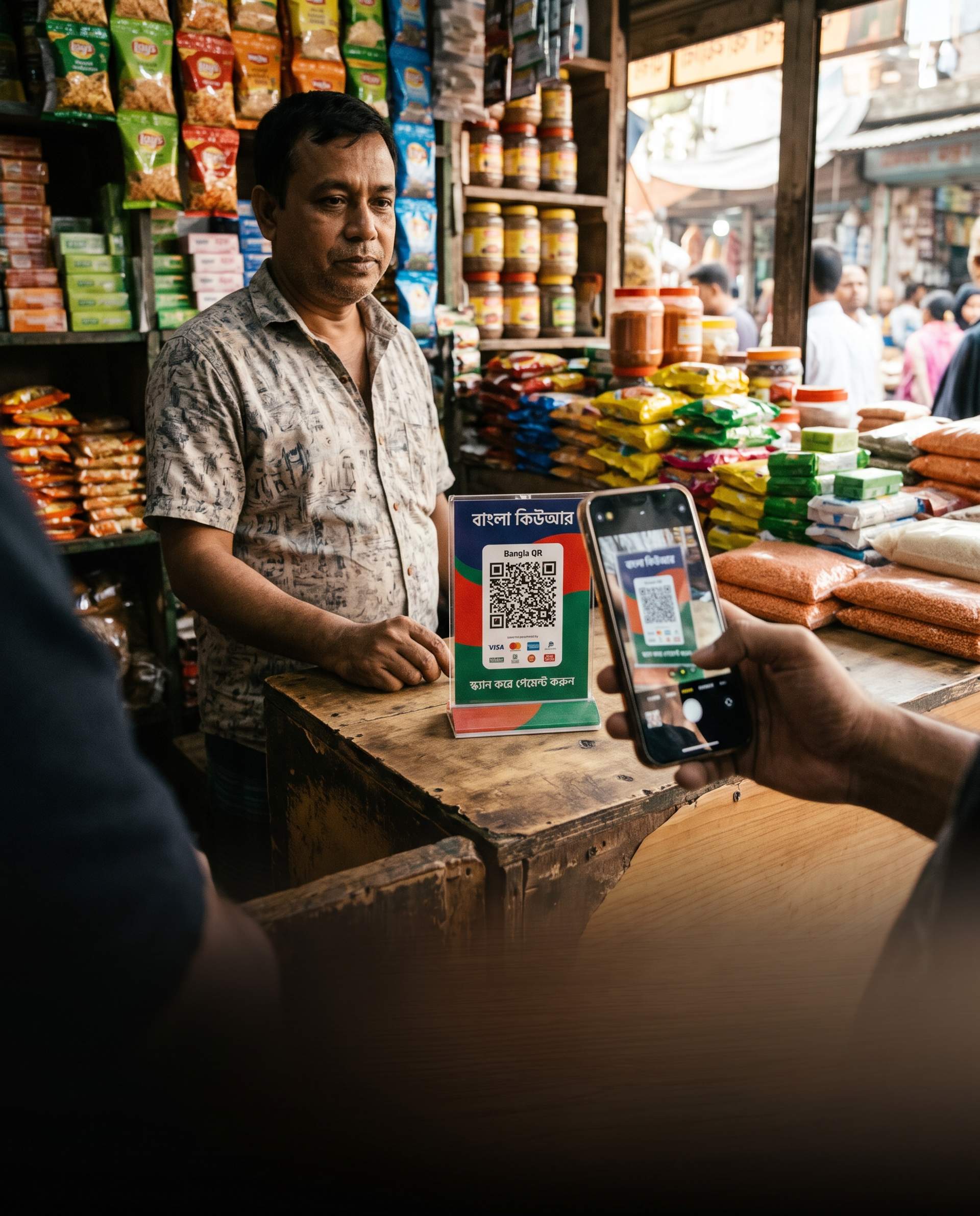
Bangladesh Bank has launched an expanded nationwide rollout of its universal digital payment system, Bangla QR, directing commercial banks, mobile financial service providers, and payment gateways to onboard small shopkeepers and rural vendors without charging merchant transaction fees.
The directive represents a concerted push by the central bank to transition everyday trade away from physical banknotes toward a unified digital payment architecture. Under the enhanced framework, a single printed QR code placed on a store counter allows customers to scan and pay using any banking application, mobile wallet, or payment card network, eliminating the need for retailers to manage multiple competing payment terminals or separate company stickers.
Overcoming Payment Fragmentation Across Local Markets
For years, the expansion of digital retail payments in Bangladesh struggled against severe fragmentation. Different mobile financial operators and private banks issued proprietary QR codes that functioned only within their own closed applications. A customer carrying money in one digital wallet was often unable to pay a street vendor who used a different service provider, forcing both parties back to physical cash.
Bangla QR solves this structural roadblock by establishing an open, interoperable national standard based on international EMVCo specifications. When a buyer scans the standardized code, the payment transaction routes instantly through the National Payment Switch Bangladesh, settling funds directly into the merchant's verified bank or mobile account within seconds.
To incentivize widespread adoption among micro-entrepreneurs, the central bank mandated that financial institutions waive the merchant discount rate on daily transactions under 20,000 taka. For roadside fruit sellers, neighborhood grocers, and rickshaw operators operating on narrow profit margins, the zero-fee rule removes the main financial barrier that previously discouraged them from adopting digital tools.
Empowering Rural Vendors and Small Businesses
The economic impact of universal QR adoption is particularly significant in rural upazilas and village bazaars, where formal bank branches are scarce and automated teller machines frequently run out of banknotes during busy market days.
Digital payment trails offer small business owners a reliable way to build verifiable credit histories. Traditionally, informal micro-merchants faced near-impossible hurdles when applying for working capital loans from commercial banks because they lacked documented turnover records or formal accounting books. By conducting transactions through Bangla QR, shopkeepers generate an automated transaction record that financial institutions can evaluate using digital credit-scoring algorithms, unlocking access to low-interest micro-loans without requiring physical collateral.
Furthermore, local trade associations point out that digital payments reduce the daily risks of cash theft, counterfeit currency circulation, and the recurring challenge of finding loose change for small transactions during peak shopping hours.
Field Support and Merchant Onboarding
To ensure that shopkeepers in rural districts can adopt the system without friction, regional commercial bank branches have partnered with local chamber of commerce associations to run hands-on verification camps. Field officers assist vendors in linking their National Identity Numbers with business trade licenses or personal merchant accounts, resolving technical queries on the spot. Early trials in pilot districts showed that once store owners realized customer money arrived instantly without hidden deductions, merchant sign-ups increased fourfold within weeks.
Reducing the National Burden of Cash Logistics
Beyond individual retailers, the transition toward cashless commerce addresses a major financial drain on the national economy. Printing, transporting, guarding, and destroying worn physical banknotes costs the central bank and commercial institutions tens of billions of taka every year.
Central bank officials noted that paper notes degrade rapidly in Bangladesh's humid climate, requiring continuous currency replacement programs. By shifting high-volume, low-value retail transactions onto secure digital rails, the financial sector can significantly lower operational overhead while bringing a larger share of the informal domestic economy into official tax and accounting systems.
Looking Ahead to Nationwide Adoption
Commercial banks and fintech firms have launched field training drives in regional hubs, educating local merchants on how to verify instant payment confirmations via smartphone alerts and audio notification boxes. Central bank officials affirmed that district monitoring committees will review local adoption progress quarterly, ensuring that merchant onboarding continues at a steady pace across every administrative division in the months ahead.




Comments
0