


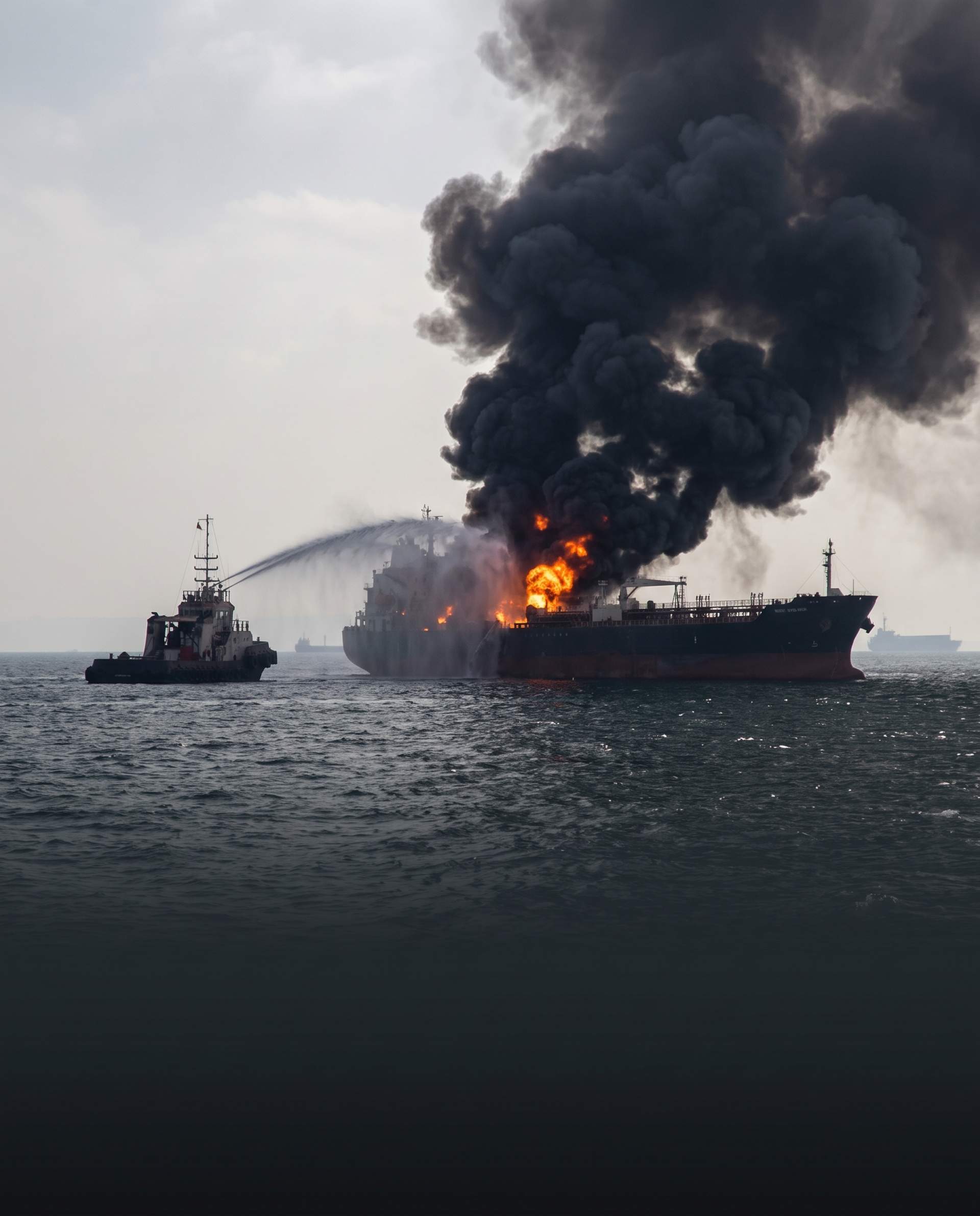
Military tensions across the Middle East flared sharply on Wednesday as the United States and Iran traded a fresh round of retaliatory strikes, hitting military installations and sparking panic across commercial shipping corridors in the Persian Gulf.
According to international defense monitors and regional reporting by Prothom Alo, the confrontation began early in the day following drone and missile attacks launched by Iranian-backed coastal units toward regional military radar posts and maritime staging areas. American forces in the region responded within hours, launching precision airstrikes against missile launch sites, coastal surveillance batteries, and weapons storage depots linked to Iran's Islamic Revolutionary Guard Corps.
The exchanges quickly spilled into international waters. During the height of the crossfire, a commercial cargo vessel transiting near the Strait of Hormuz was struck, triggering a massive blaze that sent thick black plumes of smoke billowing into the sky. Emergency firefighting tugs and maritime rescue vessels rushed to assist the burning ship, while naval authorities in Bahrain and the United Arab Emirates issued immediate navigation warnings to all merchant ships in the area.
How the Conflict Escalated Again
The latest clashes follow weeks of simmering friction between Washington and Tehran. Hostilities intensified after regional radar posts in the Gulf came under aerial drone fire earlier in the month, prompting US defense officials to bolster regional air defense batteries and deploy additional naval destroyers to the Gulf of Oman.
Tehran claimed its actions were a direct response to foreign military expansion and economic sanctions that continue to squeeze the Iranian economy. Iranian military spokespersons stated that regional defense sites were legitimate targets because foreign forces use them to monitor and restrict Iranian maritime movements.
United States Central Command confirmed the American retaliatory response, stating that US aircraft carried out strikes to degrade capabilities used to threaten merchant vessels and partner forces. Defense officials stressed that the strikes were designed to avoid civilian targets while delivering a clear warning against further maritime harassment.
Panic Across Global Oil Shipping Channels
The immediate fallout from the strikes was felt most acutely in international maritime logistics. The Strait of Hormuz is the world's most critical oil chokepoint, with roughly one-fifth of global petroleum liquids passing through its narrow waterways every single day.
Following reports of the burning vessel, several international shipping conglomerates instructed their tanker fleets to slow down or anchor in safe zones outside the Gulf of Oman. Marine insurance syndicates in London immediately widened their high-risk navigation zones, adding steep war-risk insurance premiums for any commercial ship entering Gulf waters. The sudden spike in shipping costs led to immediate volatility in global energy markets, pushing crude oil benchmarks up by more than three percent in early afternoon trading.
Maritime security analysts warn that prolonged tit-for-tat attacks could force commercial carriers to bypass the region entirely, creating severe supply chain disruptions for manufacturing hubs and energy importers around the world.
Growing Risks for South Asia and Energy Markets
For developing economies like Bangladesh, rising conflict in the Gulf brings immediate economic danger. South Asian nations depend heavily on Gulf producers, including Qatar, Saudi Arabia, and the United Arab Emirates, for vital supplies of liquefied natural gas, crude oil, and chemical fertilizers.
Higher freight rates and pricier oil imports quickly feed into domestic inflation, driving up transport costs and placing pressure on national foreign currency reserves. Government officials in Dhaka and other regional capitals are closely monitoring the developments, as any sustained disruption to Gulf tanker routes could affect winter fuel deliveries and power generation schedules.
Beyond energy imports, millions of Bangladeshi expatriates live and work across the Gulf nations. Remittances sent home by these workers form a cornerstone of the domestic economy, making long-term peace and stability in the Middle East a matter of direct national interest.
International Calls for Restraint
Diplomatic envoys from Europe and the United Nations spent Wednesday urging both Washington and Tehran to pull back from the brink of open regional warfare. European diplomats warned that unchecked tit-for-tat attacks risk pulling neighboring countries into an uncontrolled military spiral that neither side can easily contain.
While both governments have publicly stated they do not seek an all-out war, the margin for error remains dangerously narrow. With naval forces on hair-trigger alert and merchant ships caught in the middle, a single miscalculated shot or stray missile in the crowded waters of the Gulf could ignite a much larger confrontation in the days ahead.



Comments
0