


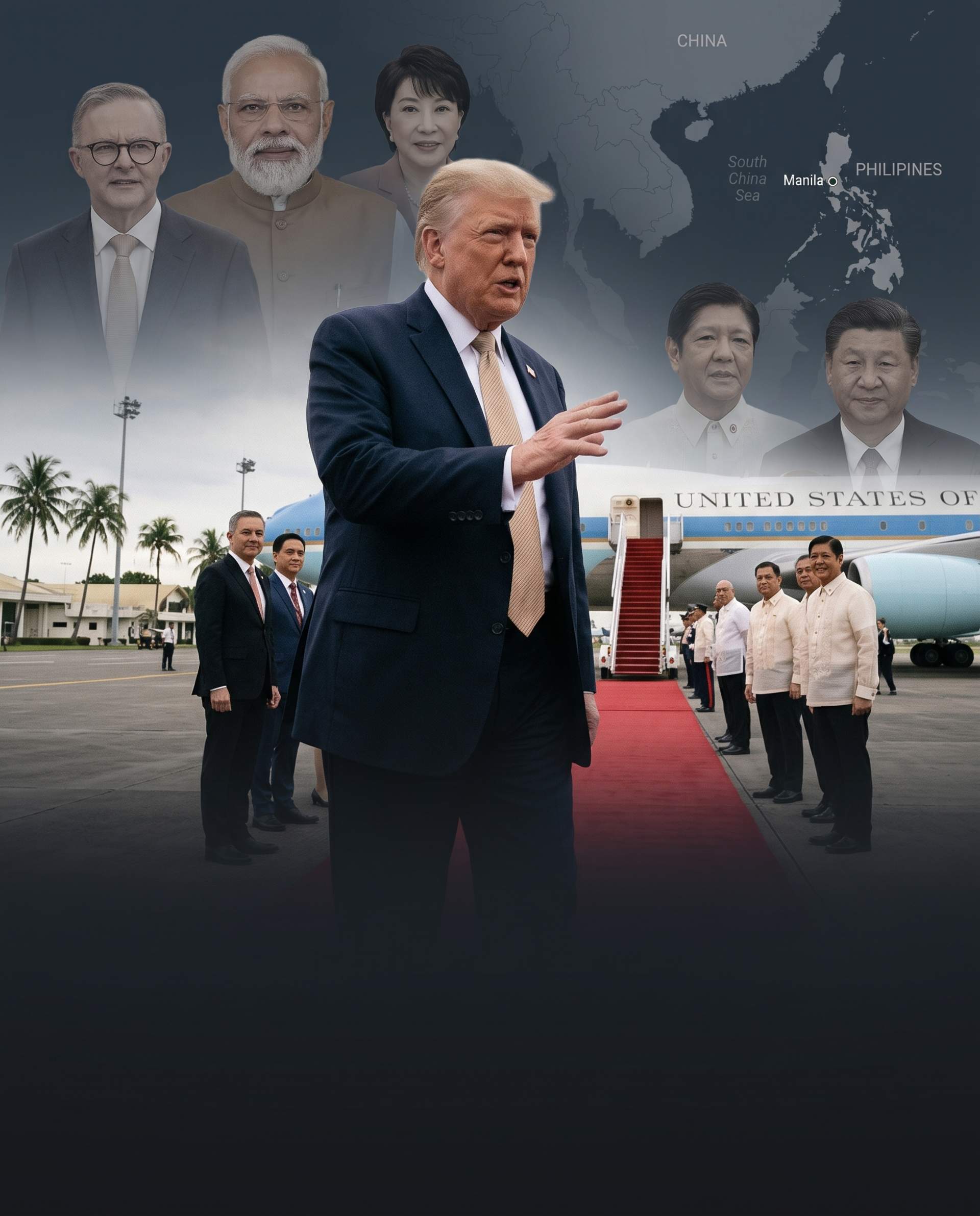
US President Donald Trump arrived in Manila on November 17 as part of a major Asia trip that brings together regional security discussions, trade negotiations and preparations for a possible meeting with Chinese President Xi Jinping and Russian President Vladimir Putin.
The visit places the United States at the centre of an important diplomatic week in the Asia-Pacific, where governments are dealing with tensions over trade, maritime security, technology and regional influence.
Trump's Manila schedule includes discussions with leaders from Japan, Australia and India through the Quad partnership, alongside engagements with Southeast Asian leaders.
He is also expected to travel to Shenzhen, China, for the Asia-Pacific Economic Cooperation forum.
The possibility of a Trump-Xi-Putin meeting later in the week has added international attention to the trip, although its outcome remains uncertain.
Why the Quad meeting matters
The Quad brings together the United States, Japan, Australia and India.
It provides a framework for cooperation on regional security, maritime awareness, economic resilience and strategic challenges in the Indo-Pacific.
Trump's meeting with the other three leaders is particularly important because it is the first gathering of the four leaders in two years, according to Reuters reporting.
The timing comes as the United States seeks to maintain its regional partnerships while managing difficult relations with China.
The countries involved share concerns about maritime security and the stability of important trade routes.
They also have interests in protecting supply chains and maintaining access to critical minerals and advanced technologies.
However, the four governments do not always have identical positions on trade and diplomacy.
India, for example, has traditionally maintained a more independent foreign policy than Washington's closest treaty allies.
That makes the Quad an important diplomatic forum, but not a military alliance with automatic obligations to respond to every regional crisis.
Technology and supply chains are central issues
The competition between Washington and Beijing extends beyond tariffs.
Advanced semiconductors, artificial intelligence infrastructure and access to critical minerals have become major elements of the relationship.
Restrictions on advanced technology exports are particularly sensitive because they affect China's ability to develop sophisticated computing systems.
The United States also wants to work with regional partners to build more resilient supply chains.
Reuters reported that discussions during Trump's trip are expected to include export restrictions, artificial intelligence, critical minerals, undersea cables and disaster relief.
These issues connect security policy with the economic interests of countries across Asia.
A disruption to undersea communication cables, for example, could affect financial transactions, internet connectivity and international business operations.
Similarly, restrictions on critical minerals can affect industries that manufacture batteries, electronics and advanced equipment.
The Quad's ability to coordinate practical initiatives in these areas will be an important measure of its effectiveness.
Manila protests add a domestic political dimension
Trump's arrival has also drawn public opposition in the Philippines.
Protests had taken place ahead of his visit, with demonstrators criticising US foreign policy and the proposed Pax Silica initiative.
The demonstrations reflect domestic concerns about the Philippines' relationship with Washington and the wider regional security environment.
The Philippines has a strategic position in the western Pacific and maintains close security ties with the United States.
At the same time, the country must manage its own relationships with China and other regional partners.
For the Philippine government, hosting a major US diplomatic visit brings both strategic opportunities and domestic political sensitivities.
The presence of protests does not mean that the diplomatic programme will necessarily be disrupted, but it demonstrates that international partnerships are also debated within the countries involved.
China becomes the next major stop
After the Manila engagements, Trump is expected to attend the APEC forum in Shenzhen.
The forum brings together economies from across the Asia-Pacific to discuss trade, economic cooperation and regional development.
The China visit is particularly significant because relations between Washington and Beijing remain complicated by tariffs, technology restrictions and broader geopolitical competition.
A fragile trade truce has provided some space for negotiations, but it does not resolve the deeper differences between the two governments.
Reuters has reported that the trip follows political developments in the United States that may influence Trump's diplomatic position, including his party's midterm election defeat.
The US-China relationship is also affected by disputes involving technology exports and allegations that have created additional pressure around the trade arrangement.
The Shenzhen meetings therefore provide an opportunity for dialogue, but they should not automatically be interpreted as evidence of a breakthrough.
The proposed Trump-Xi-Putin meeting
One of the most closely watched possibilities is a trilateral discussion involving Trump, Xi and Putin.
Such a meeting would bring together leaders from three countries with significant influence over international security and economic affairs.
The agenda could involve the war in Ukraine, the conflict involving Iran, nuclear security and wider international relations.
However, a meeting between the three leaders would not automatically mean that they could agree on major disputes.
Russia's war in Ukraine, US-China strategic competition and disagreements over regional security involve interests that cannot be resolved through symbolism alone.
Other countries also have their own diplomatic interests and are not simply passive participants in decisions made by major powers.
Ukraine, for example, has repeatedly opposed an imposed settlement that ignores its sovereignty and security concerns.
The interests of smaller states across Asia could also influence how regional agreements are implemented.
What the diplomatic week could achieve
The immediate test is whether the meetings produce concrete progress on trade, security and communication.
A successful Quad discussion could strengthen cooperation among the four countries.
The China visit could provide an opportunity to reduce tensions over trade and technology.
A meeting involving Trump, Xi and Putin could attract significant attention, but its practical importance would depend on whether the leaders agree on specific steps.
For countries across Asia, the central issue is maintaining economic and security stability while navigating competition between major powers.
Trump's visit offers an important diplomatic opportunity. Whether it produces lasting agreements or mainly political statements will become clearer as the meetings progress.



Comments
0