


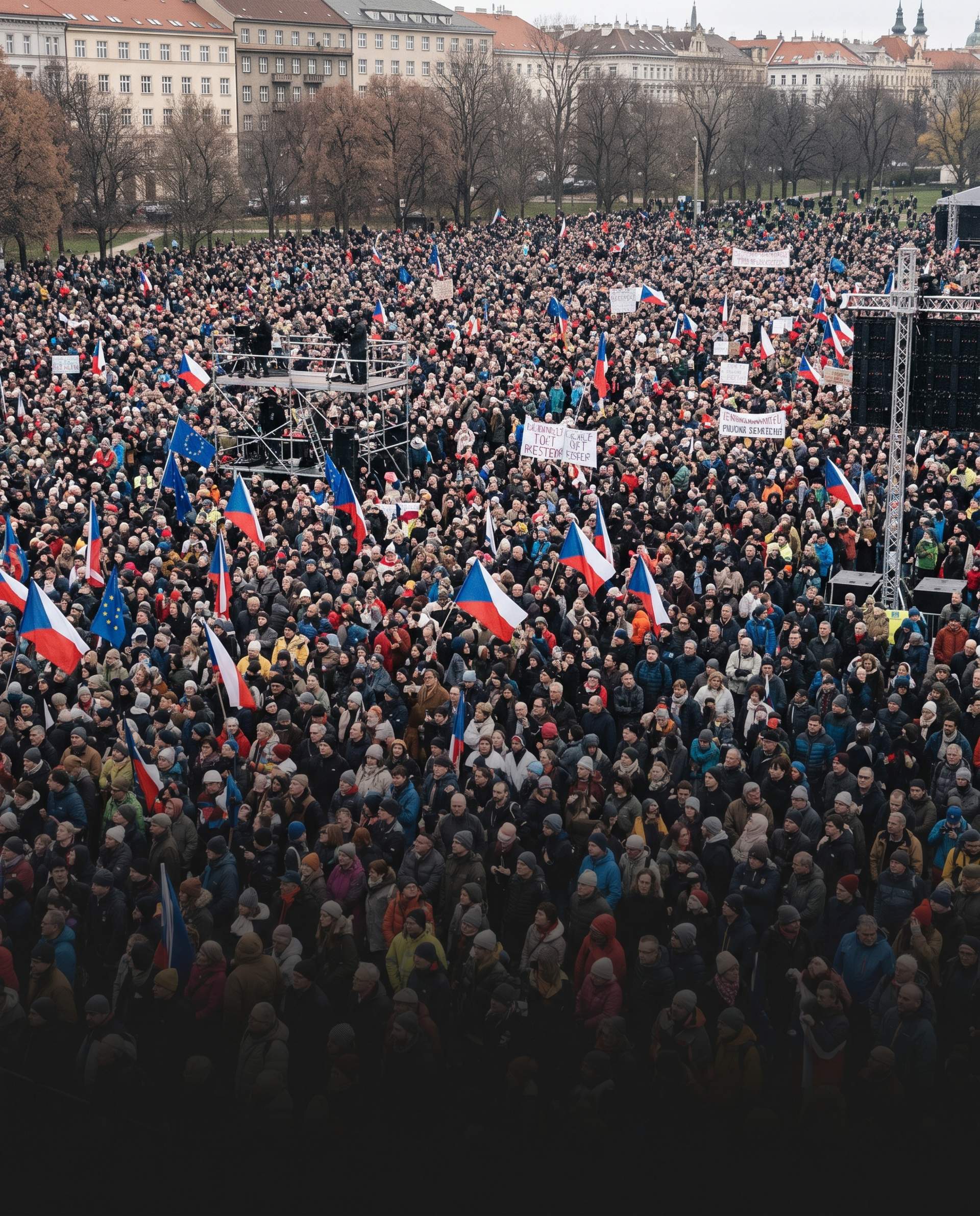
Hundreds of thousands of people gathered in Prague on November 15 to protest against the Czech government's plan to replace household and business broadcasting fees with funding from the state budget, raising concerns about the independence of public television and radio.
Organisers estimated that approximately 350,000 people attended the demonstration at Letná Park, making it one of the largest public protests in the country in recent years.
The demonstration was organised by Million Moments for Democracy and targeted a proposed overhaul of the funding system for Czech public broadcasters.
The dispute has become a major political challenge for Prime Minister Andrej Babiš and his coalition government, with opponents arguing that the proposed changes could make public media more vulnerable to political influence.
The government rejects that criticism and says the reform is intended to change how broadcasting is financed.
What are the protesters opposing?
The Czech Republic currently funds its public television and radio services through regular fees paid by households and businesses.
The government wants to abolish that system and replace it with funding from the state budget.
Under the proposed arrangement, public broadcasters would receive government-allocated funding rather than relying on the existing fee system.
Critics argue that this could weaken their financial independence.
According to reporting by Reuters and Associated Press, the proposal could reduce broadcasters' funding by approximately 15%.
Opponents warn that a reduction could lead to staff cuts, fewer programmes and reduced production.
They are also concerned that government-controlled budget decisions could create opportunities for political pressure.
The central issue is therefore not simply whether people should continue paying broadcasting fees. It is whether public media can remain independent when its financial resources depend more directly on annual government decisions.
Why did so many people gather in Prague?
The November 15 demonstration took place at Letná Park, a location with important historical associations.
Large crowds gathered there during the 1989 Velvet Revolution, which helped end more than four decades of communist rule in Czechoslovakia.
Organisers used the historical significance of the location to underline their concerns about democratic institutions and media independence.
The rally was led by the civic organisation Million Moments for Democracy.
Its organiser, Mikuláš Minář, described the gathering as extraordinary, according to reporting by the Associated Press and The Guardian.
The protest followed weeks of demonstrations in different parts of the country and a one-day strike by employees of Czech public television and radio earlier in November.
Students, cultural organisations, journalists, artists and other groups also expressed support for the broadcasters.
The demonstration therefore became broader than a disagreement about subscription fees. It reflected concerns about the government's approach to democratic institutions and public accountability.
What does the proposed funding change mean?
The financial implications are a major part of the dispute.
Reuters reported that the proposed reform could reduce public broadcasters' budgets by around 15%.
Critics say the change could leave broadcasters with less capacity to maintain their current levels of journalism and programming.
Public media organisations require stable funding to maintain news operations, regional reporting, cultural programming, educational content and other services.
A sudden or substantial reduction could create pressure to cut costs.
The more controversial question concerns the relationship between funding and political independence.
Under a household-fee system, revenue is collected through a separate mechanism rather than being determined directly through annual government budget allocations.
Moving towards state-budget financing could give the government greater influence over the overall funding process, even if editorial independence remains formally protected.
However, the existence of state funding does not automatically mean that broadcasters will become politically controlled. The actual safeguards, allocation criteria and institutional arrangements will matter.
Government rejects the criticism
Prime Minister Andrej Babiš has defended the proposed reform and rejected claims that it threatens media freedom.
He has argued that the changes will not interfere with editorial work.
The government also maintains that replacing household fees with budget funding is part of its political programme.
The coalition advanced the bill through its first parliamentary reading in October, according to reports from the Associated Press and The Guardian.
The process itself became controversial because opposition lawmakers complained that their speaking opportunities had been restricted.
The passage of the proposal through its preliminary stage prompted additional demonstrations and criticism from public-media employees.
European institutions have also expressed concerns about the need to protect public-service media financing.
EU Justice Commissioner Michael McGrath said national legislation should ensure that funding arrangements are transparent, objective, adequate, sustainable and predictable, according to Associated Press reporting.
Those principles are important because independent public broadcasters need financial arrangements that cannot easily be manipulated for political reasons.
A wider European debate
The Czech dispute is part of a broader European debate about the relationship between governments and public media.
Public broadcasters operate under different funding systems across Europe, including licence fees, taxation and mixed funding arrangements.
The choice of funding mechanism alone does not determine whether a broadcaster is independent.
What matters is whether the system protects editorial decisions from political interference and provides sufficient resources for public-service journalism.
Critics of the Czech proposal have compared it with changes to public media institutions in other European countries, particularly Slovakia and Hungary.
Such comparisons are political arguments rather than proof that the same outcome will occur in the Czech Republic.
Nevertheless, they demonstrate why the proposed changes have attracted attention beyond the country.
What happens next?
The proposed funding reform still faces further parliamentary proceedings.
The government has indicated that it intends to continue with the plan despite the demonstrations.
Opposition parties and civil society groups are likely to maintain pressure on lawmakers to reconsider the proposal.
The most important questions will concern the final funding formula, the level of financial support and the safeguards protecting editorial independence.
For Czech citizens, the issue affects more than broadcasting fees. It concerns the future of public-service journalism and the ability of national institutions to operate independently of political pressure.
The Prague demonstration has made clear that a substantial section of the public views the proposed reform as a serious democratic issue.
Whether the government changes its approach or proceeds with the legislation, the debate over who finances public media and who controls its institutional future is likely to remain an important political issue in the Czech Republic.

Comments
0