


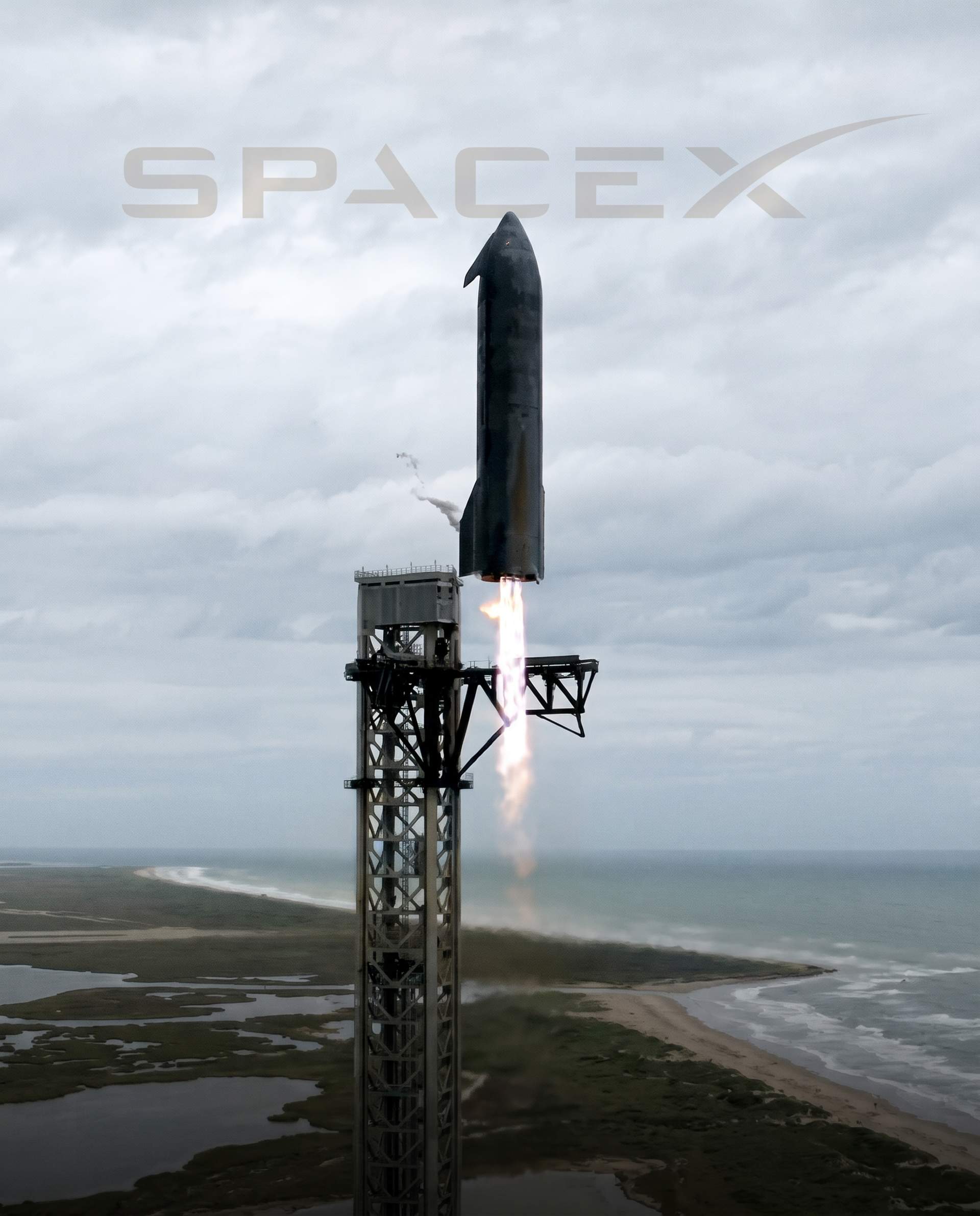
SpaceX has successfully caught its Starship spacecraft with the giant mechanical arms of its launch tower for the first time, marking a major milestone in the company's effort to develop a fully reusable rocket system.
The spacecraft returned to SpaceX's Starbase facility in South Texas on Saturday, November 14, after spending about 22 hours in space. It descended through clouds, reignited its engines to turn upright and was secured by the tower's two mechanical arms, nicknamed “chopsticks”.
The manoeuvre was the first successful tower capture of a Starship vehicle returning from space. SpaceX had previously demonstrated the technique with its Super Heavy booster, but recovering the spacecraft itself was a new challenge.
During the mission, Starship completed approximately 14 orbits around Earth and deployed 26 Starlink satellites, according to reports on the flight. The spacecraft's return also provided an important test of its ability to withstand the intense heat and physical demands of atmospheric re-entry.
However, the mission did not achieve all its objectives. SpaceX had aimed to recover both parts of the rocket: the Starship spacecraft and the Super Heavy booster that launches it. The booster failed to complete its planned return and was lost over the Gulf of Mexico after its recovery attempt was aborted.
The successful spacecraft catch nevertheless represents progress towards a launch system designed to recover and reuse both stages. Reusability is central to SpaceX's ambition to reduce the cost and turnaround time of spaceflight.
Starship is also important to NASA's lunar exploration plans. The agency has selected a Starship-based system for a role in its Artemis programme, which aims to return astronauts to the Moon. Demonstrating reliable recovery and reuse will be an important part of making the vehicle suitable for repeated missions.
The latest flight does not establish that Starship is ready for routine operational service. The booster failure, along with the need for further testing of the spacecraft and its heat shield, shows that significant engineering work remains.
For SpaceX, however, catching the spacecraft after an orbital journey is a meaningful step: the company has now demonstrated that the vehicle can return to its launch site and be captured by the tower rather than simply being discarded at sea.



Comments
0