


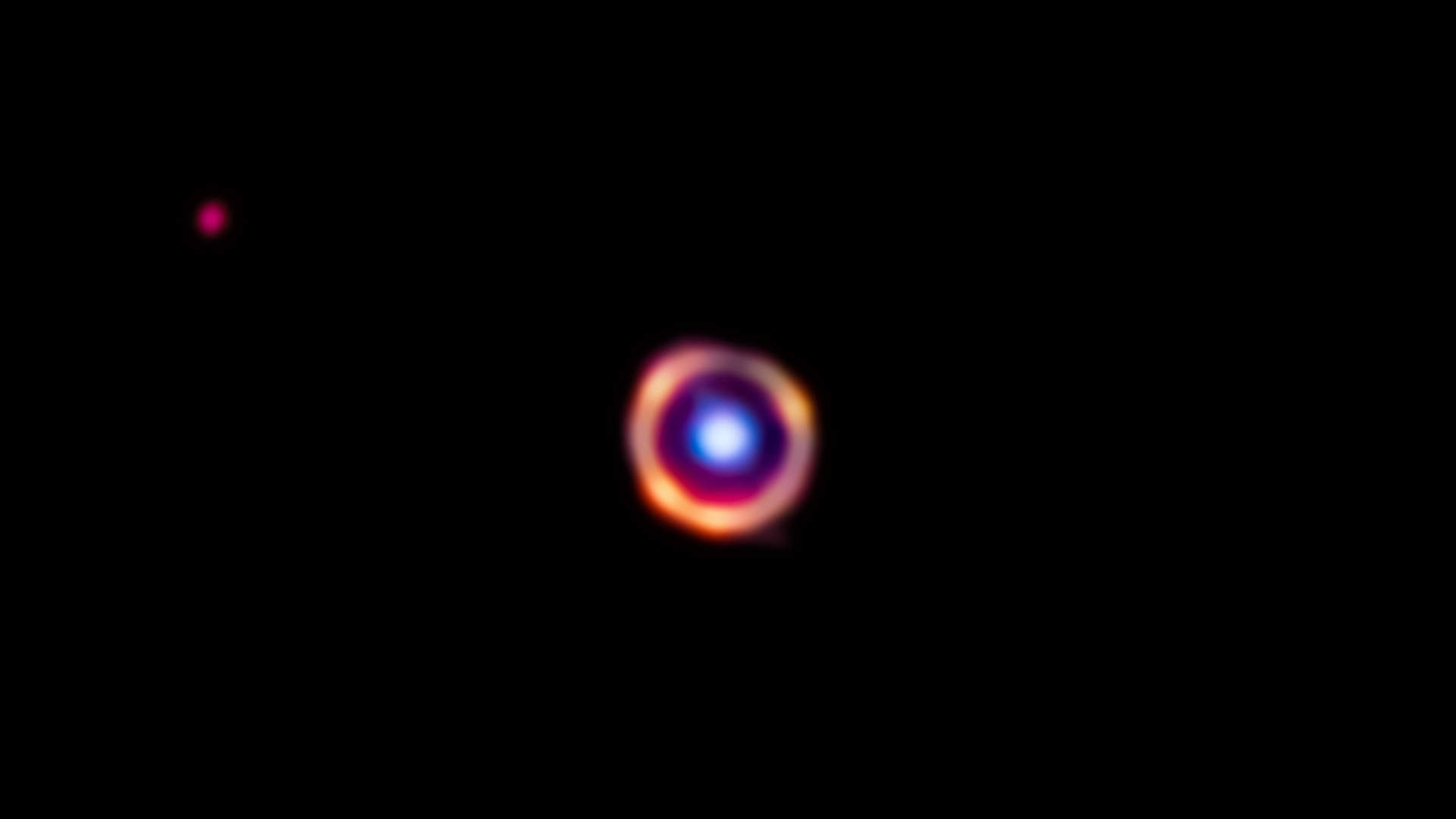
Astronomers studying data from NASA's James Webb Space Telescope have spotted complex organic molecules in a galaxy formed when the universe was less than 1.5 billion years old. The discovery is forcing scientists to rethink how quickly the ingredients for chemistry and planets came together after the Big Bang.
The research, published in the journal Nature Astronomy, focused on a galaxy named SPT0418-47. This galaxy sits more than 12 billion light-years from Earth. Inside it, researchers found clear signs of polycyclic aromatic hydrocarbons, commonly called PAHs. On Earth, these carbon-heavy compounds show up in soot, smoke, and charred toast. Out in deep space, they act like cosmic dust grains, helping interstellar gas cool down so newborn stars can take shape.
Bending Light to See Across Cosmic Time
Catching molecular signals from 12 billion years ago is remarkably difficult. Even with Webb's giant 6.5-meter gold-plated mirror, the galaxy is simply too far away to see clearly on its own.
To get a clear look, astronomers used a trick of nature called gravitational lensing. A massive foreground galaxy sits directly between Earth and the target galaxy. The gravity of that middle galaxy acts like a magnifying glass, warping and boosting the light from behind into a glowing circle called an Einstein ring. Webb's Mid-Infrared Instrument, or MIRI, captured this bent light and broke it into sharp chemical signatures.
Older space telescopes like Hubble could only see blurry patches of dust in such ancient galaxies. Webb's infrared cameras are sensitive enough to pick out the specific vibrations made by carbon rings floating in space.
Why Early Carbon Surprises Scientists
Finding large carbon molecules so early in cosmic history is a real puzzle. Right after the Big Bang, the universe had almost nothing except hydrogen and helium. Heavier elements like carbon, oxygen, and iron did not exist yet. Every speck of carbon had to be forged deep inside ancient stars and then blasted into space when those stars exploded as supernovas.
Scientists long thought this process took billions of years. The theory was that multiple generations of stars had to live and die before space held enough carbon to build complex dust grains.
Webb's data shows that chemistry was already thriving when the universe was only ten percent of its current age. Early stars must have formed, died, and scattered heavy elements much faster than standard computer models predicted.
Uneven Dust Clouds in Ancient Space
When astronomers mapped where the organic molecules sat inside the galaxy, they found another surprise. The carbon grains were not spread out evenly, and they did not always match up with areas of heavy star birth.
In nearby modern galaxies, these molecules usually glow brightest right around nurseries of young stars. But in SPT0418-47, some dense star-forming regions had almost no carbon grains at all, while quieter areas were rich with them. Scientists think fierce radiation from newborn stars or a hungry central black hole might be blasting the fragile molecules apart in certain neighborhoods while letting them thrive in shielded pockets nearby.
The Building Blocks of Future Worlds
These carbon molecules are not signs of living things, but they are essential raw materials. When planetary disks form around young stars, these carbon grains help build the foundations for rocky worlds, amino acids, and basic organic chemistry.
Webb's discovery proves that the basic ingredients needed for planets existed much earlier than anyone previously verified. The observations show that ancient environments were far richer and more chemically varied than anyone suspected.
The research team plans to point the telescope at dozens more distant galaxies in the coming months. By studying how dust and carbon behave across different cosmic eras, astronomers hope to build a clearer picture of how our universe gradually assembled the building blocks of planets and stars.



Comments
0