


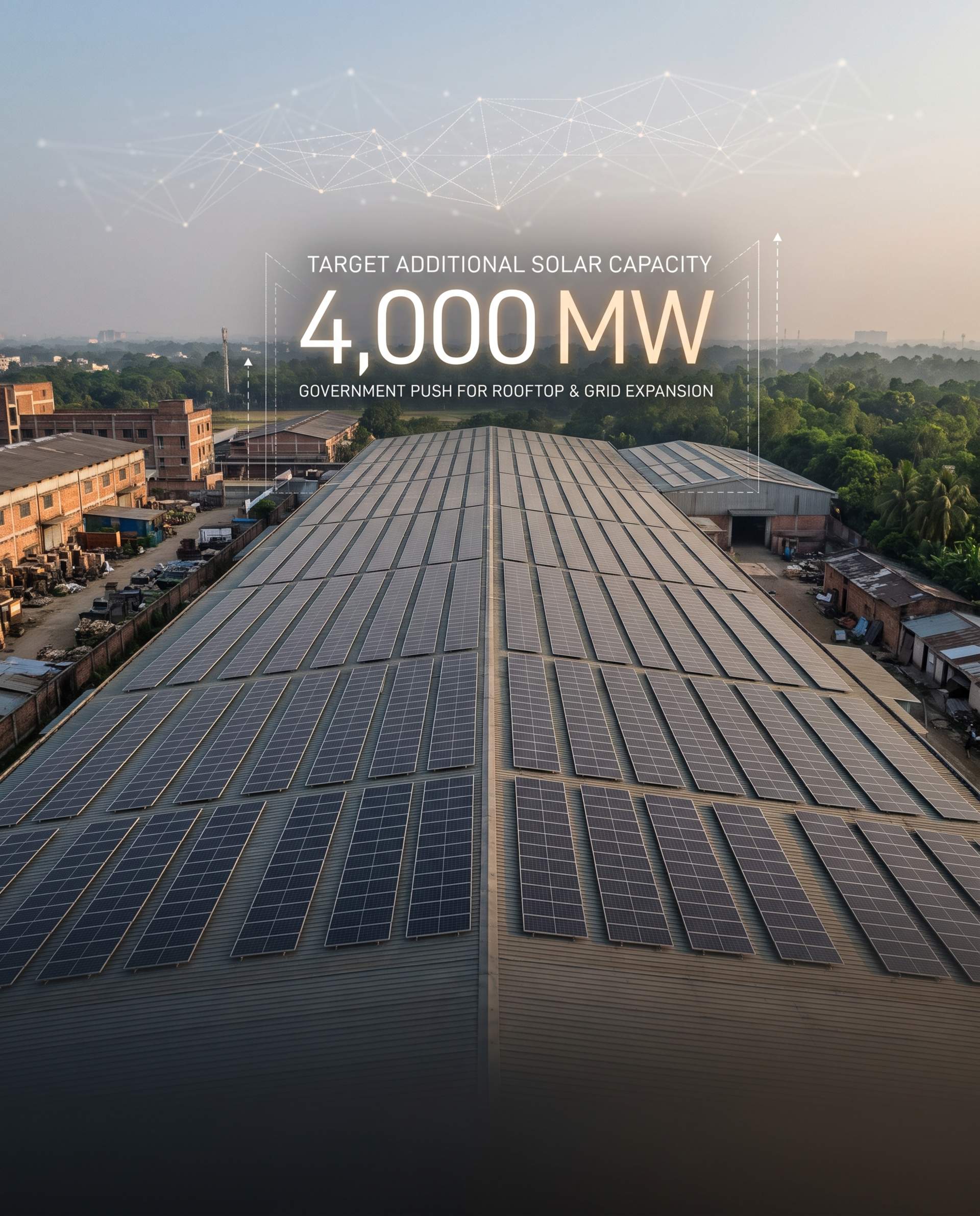
Bangladesh plans to add 3,000 to 4,000 megawatts of solar power to its national grid before next summer, an ambitious target that could help reduce the country's dependence on imported energy. But turning the announcement into electricity will require faster project development, investment and improvements in grid connections.
Prime Minister Tarique Rahman announced the target on November 3 while opening the Bangladesh Solar Expo 2026 in Dhaka. He said the government had initially allocated Tk1,500 crore to support solar expansion, with further funding to be arranged in phases.
The government also aims to generate 20 percent of the country's electricity from renewable sources by 2030 and 30 percent by 2040.
The scale of the challenge
Bangladesh has made progress in solar energy, particularly through rooftop installations at industrial facilities. However, the existing renewable-energy base remains much smaller than the government's latest ambition.
According to figures from the Sustainable and Renewable Energy Development Authority cited by Bangladesh Sangbad Sangstha on October 21, the country had around 1,935 megawatts of installed renewable-energy capacity. Solar accounted for approximately 1,642 megawatts.
The new 3,000–4,000MW target is therefore substantial. It is important, however, to distinguish between installed capacity and electricity actually delivered: solar output changes with daylight and weather, while grid-connected systems also need suitable transmission and distribution infrastructure.
New incentives, familiar obstacles
The government has introduced the Special Solar Power Installation Ordinance 2026 to accelerate projects. The law provides a framework for solar installations on rooftops, unused land, tea gardens and other locations, including floating and agricultural solar systems.
A separate incentive is designed to encourage battery-equipped rooftop systems. Eligible customers who install qualifying systems by February 28, 2027, can receive Tk10.50 for each unit of surplus electricity supplied to the national grid, under the announced scheme.
Yet policy incentives alone may not be enough. An August report by the Institute for Energy Economics and Financial Analysis identified delays in net-metering approvals as a barrier to rooftop solar adoption. Net metering allows customers to feed surplus electricity into the grid and receive bill adjustments.
The practical difficulties are visible in government buildings, too. BSS reported in October that rooftop systems installed at district and divisional commissioner offices had a combined capacity of 5.07MW, but some were still waiting for administrative and grid-connection procedures to be completed.
What needs to happen next?
The government will need to turn its target into a transparent project pipeline, showing how much capacity is already under construction, how much financing has been secured and when individual projects are expected to become operational.
Faster approvals, reliable equipment standards, accessible financing and stronger grid connections will be essential. Battery storage can also help make solar electricity more useful when sunlight is unavailable, although it adds to project costs.
Bangladesh's solar ambition is significant. Its success, however, will not be measured by the number announced at an expo. It will be measured by how much new capacity is connected, how reliably it supplies electricity and whether households and businesses see a real reduction in energy pressure.



Comments
0