

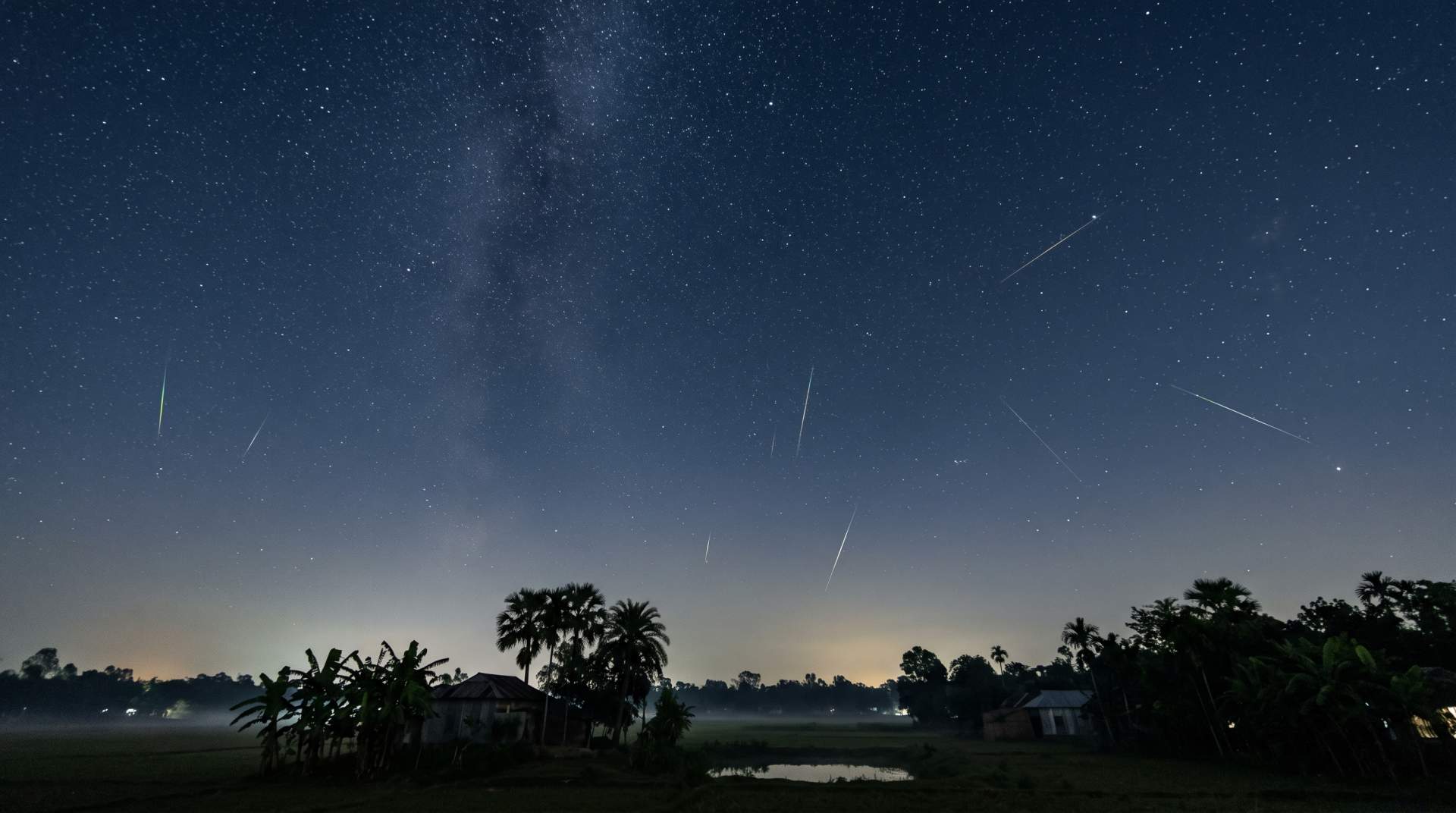
The Orionid meteor shower is reaching its peak around October 21–22, giving skywatchers across Bangladesh an opportunity to spot shooting stars created by debris from Halley’s Comet.
The annual celestial display can produce around 10 to 20 meteors per hour under ideal viewing conditions, according to NASA and the American Meteor Society. However, the actual number visible to observers will depend on cloud cover, light pollution and the brightness of the night sky.
This year, a waxing gibbous Moon illuminated by roughly 74 percent of its surface is expected to make observations more difficult during the earlier part of the night. Moonlight can wash out fainter meteors, meaning observers may see fewer shooting stars than the theoretical peak rate suggests.
Best time to watch the meteor shower
The most promising viewing period is from midnight until just before dawn, particularly after the Moon sets and darker skies return. Observers should choose a location with a broad, unobstructed view of the sky and as little artificial lighting as possible.
People in rural areas or places away from brightly lit streets and buildings may have a better chance of spotting meteors than those observing from densely illuminated urban areas. Even from cities, brighter meteors may still be visible when skies are clear.
No telescope, binoculars or other special equipment is required. The shower can be observed with the naked eye, allowing viewers to take in a wide section of the sky rather than concentrating on a small area.
For better results, observers should give their eyes around 20 to 30 minutes to adjust to the darkness and avoid looking at bright phone screens. Meteors can appear across the sky, even though the Orionids seem to originate from a point near the constellation Orion.
What causes the Orionids?
The Orionids occur when Earth passes through a stream of dust and small particles left behind by Halley’s Comet. As these particles enter Earth’s atmosphere at high speed, they heat up and produce the brief streaks of light commonly called shooting stars.




Comments
0Join the discussion
You must be logged in to leave a comment.